WORK
PROGRAMME
PROJECT
FOR THE EXPLOITATION OF RAW MATERIALS FOR CLAY ROOFING TILES AND FOR THE BRICK
INDUSTRY, WITH ENVIRONMENTAL RECOVERY
1.
INDUSTRIAL OBJECTIVES AND EXPECTED ACHIEVEMENTS
1.1.
Specification of Industrial Problem
The
production of roofing tiles and bricks in the Siena district dates back to the
time of the Etruscans, encouraged by the special chemical-physical qualities
of the clays found in the area.
The
quarrying of these materials, however, has become increasingly problematic,
due to the environmental degradation that is caused both during the quarrying
operation itself, and after the quarry has been closed. The tile industry is
therefore faced with the constantly growing difficulty of opening new, good
quality, quarries that are sufficiently near to the factories, in economic
terms (less than 10 km). There is the possibility of enlarging the existing
quarries, but this must be done using extremely modern methods, which ensure
environmental recovery during the mining phase itself, thus reducing the
environmental impact to a minimum.
The
overcoming of these problems will make it possible to continue with quality
production, even in environmentally sensitive areas.
1.2.
Objectives
The
general aim of this project is to develop a type of quarrying activity that:
uses high-quality materials, following the specification of the most
suitable process conditions for the production of roofing tiles and bricks, in
relation to the chemical and physical properties of the clay types;
has a reduced environmental impact, thanks to the adoption of a special
mine plan by trenches;
develops the environmental recovery simultaneously with the mining,
thus drastically reducing the area subject to visual environmental impact;
analyses the environmental recovery themes on the basis of the locally
available materials that can be used for filling in the quarried areas;
develops the environmental recovery simultaneously using special liners
made out of materials that can be used for the filling in of the mining areas;
studies the technical/economical of a mobile covering system which
would totally eliminate the problem of environmental impact;
The
techniques and methods used must also be economically competitive with
traditional methods and related environmental recovery techniques.
1.3.
Expected achievements
The continuation of the quarrying of high-quality clay near to the tile
production plant, with the consequent containment of transport costs; an
extremely important factor when dealing with a low-value material like clay.
A mining plan by trenches which includes immediate environmental
recovery during the mining phase, thus camouflaging the work zone as much as
possible.
An assessment of methods and materials for environmental recovery.
The defining of the technical/economic parameters for a mobile
covering, aimed at eliminating the environmental impact during the mining
phase.
2.
Economic, Industrial, Social and Environmental Benefits and
Industrial Opportunities.
2.1.
Economic potential
The
aim is to allow the continuation of an activity which would otherwise be
destined to contract through a lack of high-quality primary materials, because
of the environmental problems related to the opening of a new quarry (with the
consequent serious damage, both economical and social), whilst at the same
time maintaining the same level of management, in economic terms.
In
Italy, the annual production of kiln-fired roof tiles is estimated to be
1,350,000 tons, with the figure for Europe being 5,750,000 tons; the number of
direct employees in Italy is 1200, and number in the whole of Europe is 6000,
representing about 12% of the entire labour force in the tile production
sector. The market value of clay roofing tiles in Italy is estimated to be 100
MECU/year.
The
present market for liner material that can be used as a covering in the
environmental recovery phase during the mining operation is 50 million sq.m.,
a value of about 250 million ECU/year.
The associated ancillary items for use in land reclamation in Europe=100 million ECU.
2.1.1.
Economic justification of project
The
total cost of the project is 2.698 MECU over a
period of 3 years.
This
cost is relatively low, in relation to the size of the clay roofing tiles
market, which is 100 MECU/year in Italy alone. In Europe it is estimated to be
at about 600 MECU/year. The favourable development of this project will allow
the productive activity to continue without causing damage to the environment.
The possibility of using process plant waste as a filling material, together
with other locally procurable solid waste substances that are suitably
inertized on site, will eventually make environmental recovery at competitive
costs a viable prospect in the general scenario. It will lead to a growth in
the liners' market at an estimated annual rate of about 10% over the next
decade.
2.1.2.
Patent/Copyright possibilities
The
complete project seems to be unpatentable; the know how acquired will be
available to all those who participate in the research. The software developed
in the present project will be
protected, wherever possible, through copyright.
The
patents that can be expected from the research results will be related to the
techniques and systems used for the recycling of leachate in the waste mass,
in order to accelerate the inertization of waste products within a limited
period of time (10 years). Another patent will be related to the technical
assistance involved in the collection and exploitation of biogas during the
inertization of the waste products.
2.1.3.
Other industrial sectors
Other
industrial sectors involved in the project will include companies producing
solid waste matters that are not classified as toxic or noxious, and which
could be used as filling materials.
The
indirect ancillary market for liners consists of: the industrialized sector of
the chemical industry for plastic products, the engineering industry for the
manufacture of extruded plastic items, calenders, etc., the instruments and
services sector for the running of the plants and the development of
engineering resources. When divided up into the different sectors, this
indirect market has the following characteristics:
|
TABLE
2.3: Analysis of Global and EC Direct and Indirect Market
|
2.2.
Social and Environmental Benefits
The
inherent nature of this project will lead to both social and environmental
benefits.
Nowadays,
the opening of new quarries is strongly contested and, consequently,
employment prospects in the clay roofing tiles production sector and the tile
industry in general are directly threatened. A further consequence would be
that the subsidiary labour force, approximately equal in size to the direct
labour force, would also be ridimensioned. Another factor to be considered,
from the historical-cultural point of view, is the importance of this type of
roofing, which is such a characteristic architectural feature, both rural and
urban, of a large part of Italy and other European countries.
2.3.
Strategic importance and pre-regulation aspects
The
positive development of this project will provide the European tile industry
and quarrying in general with the tools and technology needed to create an
industrial activity that is both healthy and caring for the environment, and
which can also offer an alternative solution to the problem of solid waste
disposal.
I.L.R. will
be able to increase its production of clay roofing tiles if it can enlarge its
currently active quarries near to the factory and get rid of its processing
waste;
SLT
specializes in the production of components and systems for environmental
recovery and waste treatment, and would thus be able to extend its activity;
M.I. specializes
in the design of quarries and mines, and will draw up the trenches mining
plan, with an analysis of the methods of simultaneous environmental recovery,
with back-up from specialist sub-contractors.
The
commercial risk continuously increasing, in that the ever more restrictive
regulations in the environmental field are creating considerable operative
problems in the clay roofing tiles industry, making the opening of new
quarries a particularly difficult prospect.
3.
STATE OF THE ART AND DEGREE OF INNOVATION
Quarrying
for the clay roofing tile industry still uses traditional-type methods; the
old quarries were often opened in times when the environmental protection
regulations were not as restrictive as they are now, and the environmental of
these quarries is very often serious and frequently irremediable.
This
is making it increasingly difficult to open new quarries, which must be
located near to the processing plants, as the primary materials, being of low
value, cannot be subject to long transport distances.
Current
environmental recovery methods, which use products such as natural clay for
lining material, cannot totally guarantee the gas migration barrier; bitumen
sheets, on the other hand, are easy to use but are not very long lasting
against biological/chemical attacks, rodents and root penetration.
The
state of Art in JAPAN and USA is much less advanced than in EUROPE in this
specific field.
The
HDPE liner, 10m wide by 200 meters long, was invented in EUROPE 20 years ago,
and yet was manufactured in the USA 10 years later. Because of the
availability of space in the USA, research into and use of liners for
environmental protection was not encouraged. The raw material for liners is
polythene, derived the upgrading of crude or mineral gases (distillation
cracking, polymerization).
The
need thus arises to put forward mining plans which contain more than a simple
environmental recovery scheme for when the vein is no longer worked, as this
would leave the problem of environmental impact unresolved for a considerable
number of years. The method of mining by trenches ensures that the visual
environmental impact is kept to a minimum; the research would also look into
the design of a mobile covering system, with the aim of totally eliminating
the appearance aspect of the mining works, and also of considerably reducing
percolation due to rain water.
Finally,
a recovery scheme which works simultaneously with the productive activity
itself represents one specific aspect of the way of coping with the phenomena
of recovery and control and how these are interconnected with the mining
process itself; further studies must be made into the types of measures that
are necessary for and preparatory to the recovery, which also takes into
account the materials to be used for the filling of the quarried areas;
finally, the possibility of combining the quarrying with the disposal of
industrial waste and non-toxic and non-noxious waste in general on a
continuous basis, represents a notable development of a prospective framework
into which a mature and at risk mining activity can be fit.
The
export of technology is expected to be towards highly industrialized and
developed countries, especially in densely populated areas.
To
our knowledge, there are no national or EC-funded research projects that can
be incorporated into this work.
This
project will make it possible to assess the technical and economical
parameters for the whole cycle (quarrying, clay roofing tiles factory,
environmental recovery, waste disposal), as this assessment has not yet been
made in practice on an industrial activity that is currently in progress.
The
success of the project will emphasize the possibility of keeping currently
existing quarries open, once they have overcome the environmental problems
that are normally related to a traditional activity of this type.
4.
OVERVIEW OF TECHNICAL PROGRAMME
This
section contains an overview of the kind of technical approach that would be
needed to set up an operative process. The research tasks are described in
more detail in section 6.
4.1.
Project Structure
The
diagram below shows the main technical tasks that would be for the development
of the process, and the interrelationship between the tasks themselves.
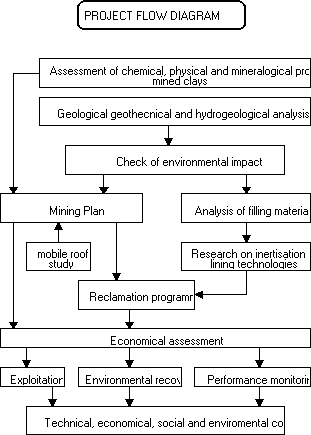
A)
Assessment of the chemical, physical and mineralogical properties of
mined clays:
A
study of the qualitative characteristics of the materials currently being
mined.
B)
Geological, geotechnical and hydrogeological analysis of sites:
A
study of the hydrogeological and geomechanical conditions of the current
quarrying zones. The study will centre on an assessment of the underground
water layers and of the geo‑mechanical/hydraulic situation of the rocks
in the quarrying zone.
(The
above tasks must be carried out even though they are not part of the project
itself).
1)
Assessment of environmental compatibility:
On
the basis of the results of points 1) and 2), the most suitable areas for
productive activity with the proposed methods will be identified. The local
surrounding conditions will also be analyzed for an identification and
quantification of the possible constraints on mining activity.
2)
Study of filling materials:
The
possible materials that can be used as fillers will be identified. The
materials available in the zone will be classified, such as the waste material
from the tile industry and other industries, etc.
3)
Study of lining and inertization techniques:
A
study will be made of the possibility of using HDPE liners for the isolation
and inertization of the filling materials.
4)
Study of a mobile covering:
A
technical-economical study of a mobile covering for the areas being mined,
together with a simultaneous recovery system, aimed at eliminating the visual
impact.
5)
Mining plan:
The
study and drawing up of a mining plan by trenches, on the basis of points 1)
and 3).
6)
Recovery plan:
A
study of a recovery plan for the mined areas, aimed at developing a
mining-filling cycle, with the planting out of suitable vegetable species and
the definitive setting out of the water system in the area.
7)
Assessment of Economic viability of the test operation:
An
evaluation of the economic viability of the entire project, with a comparison
with current mining costs and traditional recovery methods will be made.
8)
Mining, environmental recovery and environmental monitoring
The
operative phase of the project with simultaneous experimental mining by
trenches, filling of the mined zones and environmental monitoring.
9)
Evaluation:
The
results of the experimental mining will be assessed, along with their validity
on a large scale, from the technical, economic, employment and environmental
point of view.
4.2.
Project Methodology The study of a quarry that is mined and recovered
on a continuous basis involves the following main research tasks:
Chemical, physical and mineralogical tests on clays
Hydrogeological, Geological and geotechnical analyses, aimed at
choosing the most suitable sites
Assessment of environmental compatibility
Selection of the filling materials and a study of their
chemical-physical-mechanical characteristics
Assessment of on-site lining and inertization techniques
Study of a mobile covering
Mining plan
Environmental recovery plan
Assessment of Economic viability of the test operation
On-site testing of the mining-filling method
Evaluation of results, and forecasts for the large-scale application of
the proposed methods.
4.2.1.
Hydrogeological, Geological and geotechnical analyses aimed at choosing
the most suitable sites
Theoretical
analysis and tests for the assessment of possible sites in currently mined
zones where the project is to be made operational. The geological and
geotechnical characteristics of the land in the zone will be studied, by means
of field tests and laboratory tests.
4.2.2.
Chemical, physical and mineralogical tests on clays
The
technological characteristics of the clay types currently being mined will be
identified by means of chemical analyses, mineralogical tests, drying and
firing tests and mechanical tests, in order to verify the suitability for
production, and for the specific production of high quality clay roofing
tiles.
4.2.3.
Assessment of environmental compatibility
On
the basis of the geological-structural and geotechnical characteristics,
together with the hydrogeological situation, the most suitable sites for the
carrying out of the project will be identified.
4.2.4.
Selection of the filling materials and a study of their
chemical-physical-mechanical characteristics
The
various materials available in the zone that can be used for fillers will be
classified on the basis of their chemical-physical-mechanical properties. The
materials will be selected from the waste products of tile factories and other
local industrial plants, etc.
4.2.5.
Assessment of lining and on-site inertization techniques
HDPE
liners will be used for lining.
4.2.6.
Study of a mobile covering
A
technical-economic study will be made of the application of a mobile covering
above the mined areas; this covering will practically eliminate the visual and
appearance aspect of the mined zone.
4.2.7.
Mining plan
Study
and drawing up of a mining plan, aimed at reducing the visual impact of the
mining activity, with mining and recovery by trenches.
4.2.8.
Environmental recovery plan
An
environmental recovery plan for the end of the productive cycle in the mined
zone will be drawn up. A study will be made of the planting of local tree
species that are compatible with the soil, made up from inertized filling
material, for the reforestation of the area. The definitive plan for the water
system in the area will also be drawn up.
4.2.9.
Assessment of economic viability of the test operation
A
technical-economic analysis of the productive activity and planned recovery
will be made, in order to assess the economic viability of the project.
4.2.10.
On-site testing of the mining-filling method
An
experimental mining project will be set up in the selected zone, using the
combined quarrying-filling-inertization recovery cycle described above. An
environmental monitoring system will be set up that will continue to operate
after the completion of the test.
4.2.11.
Evaluation of results, and forecasts for the large-scale application of
the proposed methods
The
results of the on-site tests will be compared with the project hypotheses. The
environmental monitoring data will be assessed. The results will be used to
update the economic study for large-scale application, and for an assessment
of the social-environmental consequences.
4.3.
Assessment of technical risks
The
following technical risks are considered as being critical to the success of
the project:
Given the need to develop a complete cycle project, it is essential
that an assessment is made of the constraints on mining and simultaneous
recovery, and of the economic viability of the various possibilities.
The possible systems must be adaptable to other situations in the
quarrying sector, and to the various types of materials that can be used for
the recovery.
It
is believed that the initial risk is to be considered as high as regards the
feasibility of a mobile covering, given the considerable costs that this will
entail, whilst the risk is limited for all the other aspects of the project,
as the environmental regulations are constantly imposing the quest for
innovative solutions to traditional-type quarrying, and the lack of an answer
is already creating difficulties for clay roofing tiles concerns, due to a
progressive lack of raw materials.
The
risks regarding pollution of the water table are negligible, as the bottom
liner and lining installation conforms to the most advanced requirements and
rules set down by the authorities, such as the EPA (U.S.A.) and the TA-Abfall
(Germany).
The
main threat to the research project is the extent of time needed for the
inertization of waste materials.
There
are no risks for other types of environmental impact, apart from those which
can already be applied to the standard landfill practices currently in use.
5.
PROFILE OF CONSORTIUM
Table
5.1 Overview of participants.
|
Partner |
I.L.R. |
SLT |
M.I. |
|
Role |
PC |
PR |
PR |
|
Type |
IS3 |
IS3 |
IS5 |
Table
5.2 Tasks assigned to partners
|
Tasks
per partner Description |
I.L.R. |
SLT |
M.I. |
|
Task
1 |
XXX |
XX |
X |
|
Task
2 |
XXX |
XX |
|
|
Task
3 |
|
XXX |
XX |
|
Task
4 |
X |
|
XXX |
|
Task
5 |
XX |
X |
XXX |
|
Task
6 |
XXX |
XX |
|
|
Task
7 |
|
|
XXX |
|
Task
8 |
XXX |
XX |
X |
|
Task
9 |
XX |
X |
XXX |
XXX
-
Leading Partner
XX
-
Assisting Partner
X
-
Minor Assisting
5.1.
Contribution Of Partners And Responsibilities
I.L.R. is
an industrial concern of size S3, the main activity being the production of
clay roofing tiles and bricks, together with the running of a clay quarry.
The
main tasks of I.L.R. (project coordinator) are:
Task
1
Assessment of environmental compatibility
Task
2
Selection of the filling materials and a study of their
chemical-physical-mechanical characteristics
Task
4
Study of a mobile covering
Task
5
Mining plan
Task
6
Environmental recovery plan
Task
8
On-site testing of the mining-filling method
Task
9
Evaluation of results, and forecasts for the large-scale application
of the proposed methods.
I.L.R.
will take on the responsibility for obtaining deliverables for tasks 1,2,6,8.
Personnel:
1
Senior Engineer
1
Junior Engineer
Senior Technicians (22% of the
manpower)
Mine Personnel
Equipment
available:
Mine infrastructure
Center support equipment
General use trucks
Equipment
to be charged to the project:
1
Excavator
1
Wheel loader
1
Bulldozer
1
Landfiller
1
Dumper
I.L.R.
personnel will carry out all the necessary preparatory tasks as well as the
actual exploitation of the quarry and all the activity needed for the
landfilling of the wastes.
This
personnel will consist mainly of operators as well as survey staff.
(Technician 70% Senior Technician 22% Junior Engineer 6% and Management 2%).
The
charge will correspond to the period o f the mine test
I.L.R.
will also provide the land and all the ancillary works needed by research and
the further exploitation of the site.
SLT is an
industrial concern of size S3, the core business interest being the
manufacture of large-sized HDPE Liner. SLT is also a leader in the development
of liner systems for application in canal protection systems, sewage canals,
storage basins for chemicals, etc. It has also developed a barrier system to
prevent gas penetration from toxic wastes, aimed at protecting the health of
inhabitants and avoiding possible ecological disasters and disease epidemics,
etc. Its main role in the research is:
Task
1
Assessment of environmental compatibility
Task
2
Selection of the filling materials and a study of their
chemical-physical-mechanical characteristics
Task
3
Assessment of on-site lining and inertization techniques
Task
5
Mining plan
Task
6
Environmental recovery plan
SLT
will take on the responsibility for obtaining deliverables for task 3
SLT
is in charge for designing, engineering and installation of landfill, with
lining system facilities for leachate and biogas.
Personnel:
1
Technical director
1
Senior Engineer
1
Junior Engineer
1
Lining crew of 7-8 people
The
on site operation will be supervised by the local representative of SLT.
Required
equipment consist mainly of power generators, hoisting and welding equipment.
The main idea behind the reclamation project is the one of containing the
materials inside watertight cells letting all the processes to happen in a
controlled environment. The process entails the possibility of quickly
insulate the material before the insurgence of scents or other bothersome
reactions.
Equipment
available:
Power generator
Hoisting equipment
Front end loaders
Compacter
Equipment
to be charged to the project:
Welding equipment
Testing equipment
SLT will provide the linings (HDPE, protection layers, draining piping
and related equipment), the facilities necessary for leachate and biogas
generated from the wastes encapsulated in the landfill.
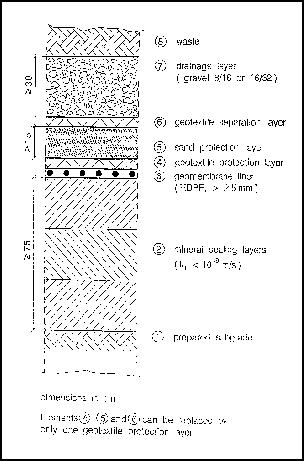
Layers of the complete
lining system.
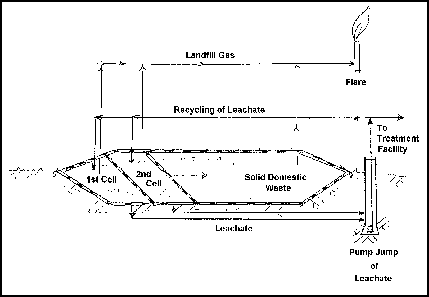
Sketch of the complete
system.
It is estimated that about 15.000 m² of HDPE lining 2mm will be
necessary for the three consecutive cut-and-fill rounds. The same amount is
estimated for the other layers forming the complete lining system.
The liners must be regarded as a part of a complete system as it is
outlined in the sketch.
M.I.
is an industrial concern of size S1, part of a mining group of size S5, and
its main roles in the research project are:
Task
1
Assessment of environmental compatibility
Task
3
Assessment of on-site lining and inertization techniques
Task
4
Study of a mobile covering
Task
5
Mining plan
Task
7
Assessment of Economic viability of the test operation
Task
8
On-site testing of the mining-filling method
Task
9
Evaluation of results, and forecasts for the large-scale application of
the proposed methods.
M.I.
will take on the responsibility for obtaining deliverables for tasks 4,5,7,9
M.I.
will provide mining engineers and software experts. The mining engineers to be
employed in the project are:
two
mining engineers with more than twenty years experience in open pit and
underground mines in Italy and abroad.
one
mining engineers with experience in R & D, geotechnical studies and
environmental monitoring and control.
Existing
computing facilities and specialized software will be employed.
The
software expert is one PHD in Physics, specialized in computer application for
technical and scientific research, including design of monitoring system also
with specific original software.
Existing
computer facilities, as PC386, HP Laserjet III printer, Plotter A4 and
specialized software as MAGMA, OP.Mine, Mining Italiana original package for
technical and economical analysis of open mines, will be employed.
One PC
and a plotter will be purchased for the research purposes.
The
partnership structure, therefore, consists of a company that manages the
quarrying activity and the production of clay roofing tiles bricks (I.L.R.), a
company that is active in the environmental recovery sector (SLT), and a
company with expertise in the design and running of a complete mining cycle
(Mining Italiana).
I.L.R.
has several quarries, one of which will be made available for the research.
6.
DETAILED DESCRIPTION OF TASKS
The
project will take as its starting point the work that has already carried out
by the individual partners in their own specific fields of activity. The
partnership will develop a collective technique, as described above. The
quarry itself, along with the dumping materials to be studied in the project,
is outlined below:
The quarry is located in Monte Martino near the plant where the clay is
to be used and where clays are particularly suitable for the production of
roof tiles .
The dumping materials consist of processing waste from the clay roofing
tiles factory and industrial waste products from other industries in the area,
etc.
Task A
Hydrogeological,
Geological and geotechnical analyses, aimed at choosing the most suitable
sites
Objectives
The scope of the first task is to define the geo-structural
characteristics of the geological formations that will be affected by the
mining. Also, the hydraulic features and the underground and above-ground
water systems will be defined. The geomechanical properties will be studied.
Starting point
All that is available is a general geological knowledge derived from
regional surveys, along with the know-how gained during the mining phase.
Technical approach
A detailed geological survey will be carried out the zone. Piezometers
will be used to identify the underground water system. The surface water
system will be studied, in order to protect it during the mining with the
proposed methods. A study of the mechanical features will be made, by running
tests on undisturbed samples. The core samples will be sent to a geotechnical
laboratory for the necessary tests.
Task B
Chemical, physical and
mineralogical tests on clays
Objectives
The aim of this task is to classify the mined material for the production
of clay roofing tiles and bricks in order to assess the suitability of the
potential quarrying sites and to set the size of the mining site.
The economic savings obtained with the use of new firing techniques can
be used to compensate the additional cost of improving the quality of the clay
material. This will give a wider choice of quarrying sites that lie within an
economical distance and will therefore lead to a reduction of the problems
caused by environmental constraints and increased production and employment
possibilities.
Starting point
A knowledge of the clay materials extracted up to present is available.
Technical approach
This research activity will be divided up as follows:
Identification of the correct sampling procedure for the quarried
product.
Mineralogical classification of the clay materials.
Physical-chemical classification of the clay types from the potential
quarrying sites, using a series of standard tests:
moisture content, weight loss during calcination (by Thermogravimetry),
silica, aluminium, iron, calcium, magnesium oxides, alkaloid oxides,
sulphates, carbonates, humic acids, impurities content and level of
plasticity.
Mechanical characterization of laboratory- manufactured articles made
from the extracted materials under different firing conditions.
The development of new processes and new formulations for the
production of clay roofing tiles, based on the clay materials extracted from
the quarrying site:
The development of a chemical process for improving the quality of the
poorer quality clay excavated from mining sites which lie within an economical
distance and which have a low environmental impact.
The assessment of microwave processing as a potential alternative
technology for the drying of ceramic materials, geared towards the production
of improved quality bricks with shorter processing times and lower production
costs. In fact, a rapid and uniform heating effect can be achieved with
microwave firing, even with large-size objects. A uniform heating process is
essential to avoid thermal stresses that lower the mechanical properties of
the product.
Task 1
Assessment of
environmental compatibility
Objectives
Task 1 aims to assess the environmental impact of the activities related
to the exploitation of the possible test sites with the proposed innovative
method.
Starting point
The zones in which the test site will be located are known and near by
clay quarries are currently exploited.
Technical approach
An analysis of the geo-structural and hydrogeological characteristics of
the formations to be affected by the productive activity, along with a study
of the local water system; the results will be used for a more precise
definition of the site for the experimental mining.
|
Partner |
Man months |
|
I.L.R. |
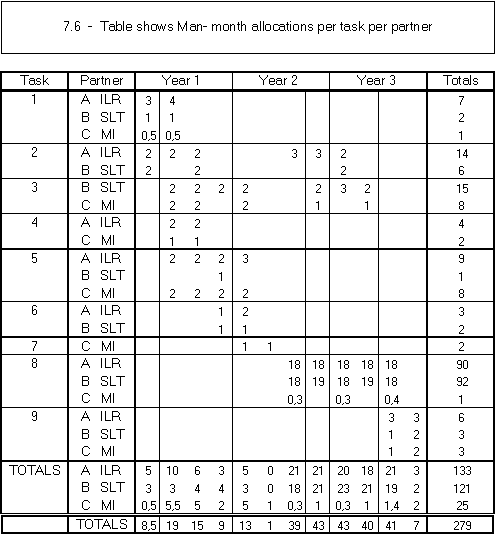
7 |
|
SLT |
2 |
|
M.I. |
1 |
Deliverables
Environmental impact study (Month n°6)
Interdependence with other tasks
Task 1 provides input for Task 5
Duration
6 months; from month 1 to month 6
Subcontractors
S-ILR-A , S-ILR-B and S-ILR-C Involved in this Task
Task 2
Selection of the filling
materials and a study of their chemical-physical-mechanical characteristics
Objectives
The aim of task 2 is to identify and select the most suitable materials
to be used as fillers.
Starting point
The places where these materials are produced are known.
Technical approach
The classification of the filling materials available in the zone will be
carried out on the basis of the chemical‑physical-mechanical
characteristics. The materials will be selected from the industrial waste
produced by the brickworks and other local industries, etc. Physical-chemical
tests will be made in accordance with currently binding environmental
regulations. The mechanical features, deformability and resistance and the
granulometric composition will be determined by laboratory tests. Also, the
permeability coefficient of the material will be determined.
|
Partner |
Man
months |
|
I.L.R. |
14 |
|
SLT |
6 |
|
M.I. |
- |
Deliverables
Specialist technical reports describing:
4. Results of studies of filling material (Month n° 9)
Interdependence with other tasks
Task No. 2 provides input for task 5
Duration
9 + 9 months; from month 1 to month 9 and month 19 to month 27
Subcontractors
S-SLT-B Involved in this Task
Task 3
Assessment of lining and
on-site inertization techniques
Objectives
Task 3 sets out to define the most suitable techniques for the lining and
for the on site inertization of the disposed materials. The aim is to
incorporate these operations directly in the productive cycle of the quarry,
and not to postpone them until when the quarry is exhausted.
Starting point
The starting point consists of the know-how of SLT, the manufacturer of
non-biodegradable HDPE liner and of the input of the academic experts.
Technical approach
After an in-depth site survey, a detailed topographical survey will be
conducted in the experimental mining zone. A plan for the lining will be drawn
up, together with an outline for the inertization system using the leachate
recycling system.
|
Partner |
Man
months |
|
I.L.R. |
- |
|
SLT |
15 |
|
M.I. |
8 |
Deliverables
Specialist technical reports describing:
Results of the studies of treatment and confinement systems for the
filling materials (Month n° 15)
Interdependence with other tasks
Task 3 requires input from task 1
Task 3 provides input for task 5
Duration
12 + 9 months; from month 4 to month 15 and month 21 to month 30
Subcontractors
S-SLT-A, S-SLT-B and S-SLT-C Involved in this Task
Task 4
Study of a mobile covering
Objectives
The objective of task 4 is a technical-economical study of mobile
coverings to shield the quarrying operations from view. Methodologies and
computer simulation programs for detecting and avoiding future optical
pollution will be developed.
Starting point
There are no known analogous experiences in the quarrying sector.
Technical approach
The technical-economic study will center on the static and mechanical
design of the covering, evaluating the single cost items and the probable
investment needs for the particular test site.
|
Partner |
Man
months |
|
I.L.R. |
4 |
|
SLT |
- |
|
M.I. |
2 |
Deliverables
Specialist technical reports describing:
The methodology and mobile covering design (Month n° 9)
Interdependence with other tasks
Task No. 4 provides input for task 5
Duration
6 months; from month 4 to month 9
Task 5
Mining plan
Objectives
Task 5 aims to study the mining by trenches method which will allow for
the filling with the materials selected in task 2, to be combined with the use
of the mobile covering, and with the methods in task 3, in conditions of
absolute environmental safety.
Starting point
The know-how acquired in the previous tasks.
Technical approach
A mining method will be developed which will allow for the simultaneous
treatment and filling between the mining phases. A permanent monitoring system
will be drawn up which will control the conditions of the surface and
underground water deposits, checking that there are no emissions of pollutant
substances into the work environment and the zones around the quarry.
|
Partner |
Man
months |
|
I.L.R. |
9 |
|
SLT |
1 |
|
M.I. |
8 |
Deliverables
Specialist technical reports describing:
Mining plan (Month n° 15)
Interdependence with other tasks
Task No. 5 requires input from tasks 3 and 4
Task No. 5 provides input for tasks 6, 7 and 8
Duration
12 months; from month 4 to month 15
Subcontractors
S-ILR-A , S-ILR-C Involved in this Task
Task 6
Recovery plan
Objectives
Task 6 aims to set out the reclamation operations that will be required
when the mining is finished.
Starting point
The know-how acquired in the previous tasks and in similar operations
carried out by I.L.R. and SLT.
Technical approach
The operations after the mining involve the planting of vegetable species
that are known to be compatible with inertized land surfaces plus the related
water system works.
|
Partner |
Man
months |
|
I.L.R. |
3 |
|
SLT |
2 |
|
M.I. |
- |
Deliverables
Recovery plan (Month n° 15)
Interdependence with other tasks
Task No. 6 requires input from task 5
Task No. 6 provides input for tasks 7 and 8
Duration
6 months; from month 10 to month 15
Subcontractors
S-ILR-B, S-SLT-A and S-SLT-C Involved in this Task
Task 7
Assessment of Economic
viability of the test operation
Objectives
The objective of task 7 is the economical review of the project.
Starting point
The know-how acquired in the previous tasks and the experience gained by
M.I. in this field.
Technical approach
An assessment will be made of the operational and capital costs of the
project. After making a hypothetical forecast of the plant depreciation time,
a financial model will be constructed for the calculation of the IRR and NPV.
The comparison will be made using the current method.
|
Partner |
Man
months |
|
I.L.R. |
- |
|
SLT |
- |
|
M.I. |
2 |
Deliverables
Specialist technical reports describing:
Results of the economic study (Month n° 18)
Interdependence with other tasks
Task No. 7 requires input from tasks 5 and 6
Task No. 7 provides input for task 8
Duration:
6 months; from month 13 to month 18
Task 8
On-site testing of the
mining-filling method
Objectives
Task 8 aims to provide an operational assessment of the project.
Starting point
The know-how acquired in the previous tasks and the experience gained in
this sector by I.L.R. and SLT and the sub-contractor.
Technical approach
An experimental mining by trenches scheme will be set up, combining the
quarrying, lining and waste filling phases into a single cycle, using the
methods devised in the previous tasks. During the mining, the environmental
monitoring system drawn up in task 5 will be set up, which will continue to
operate after the mining.
It is estimated that each
trench will involve an excavation of about 10.000 m³ in a depth of about 20
m. Three such trenches will be excavated, lined and filled during the test.
The lining estimated as necessary will be about 15.000 m² composed of
multiple layers according to the plan established in task 5 and existing
regulations. The system will be completed with the needed leachates and gas
control piping and equipment.
The lining will be provided by SLT.
|
Partner |
Man
months |
|
I.L.R. |
90 |
|
SLT |
92 |
|
M.I. |
1 |
Deliverables
none
Interdependence with other tasks
Task No. 8 requires input from tasks 5, 6 and 7
Task No. 8 provides input for task 9
Duration
15 months; from month 19 to month 33
Subcontractors
S-ILR-C, S-SLT-A, S-SLT-B and S-SLT-C Involved in this Task
Task 9
Evaluation of results, and
forecasts for the large-scale application of the proposed methods.
Objectives
The objective of task 9 is to evaluate the results of the project.
Starting point
Data from mining work and environmental recovery
Technical approach
The technical-economic data from Task 8 will be analyzed in order to set
out the basic procedures and their scale-up, paying particular attention to
any social or economic benefits.
|
Partner |
Man
months |
|
I.L.R. |
6 |
|
SLT |
3 |
|
M.I. |
3 |
Deliverables
Specialist technical reports describing:
Results of on-site tests and assessments (Month n° 36)
Interdependence with other tasks
Task No. 9 requires input from task 8
Duration
6 months; from month 31 to month 36
Subcontractors
S-ILR-A , S-ILR-C , S-SLT-A and S-SLT-C Involved in this Task
Task 10
Project Management
Approach
See section 7, management of the project
|
Partner |
Man
months |
|
I.L.R. |
4 |
|
SLT |
2 |
|
M.I. |
2 |
7.
PROJECT MANAGEMENT
7.1.
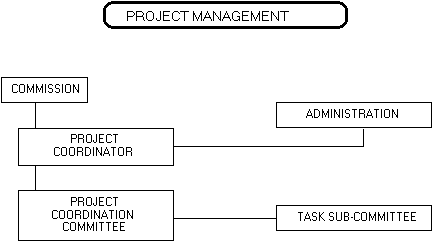
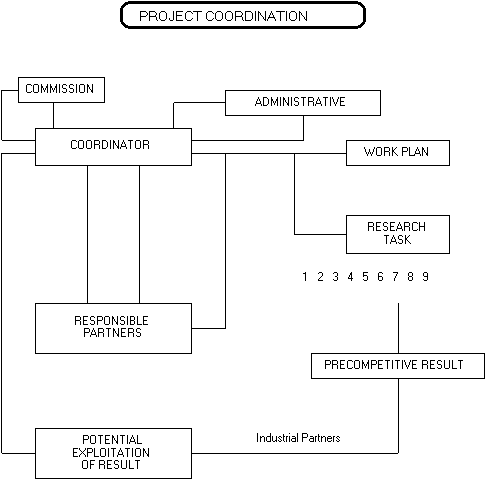
Overall organization (Figures 2 and 3)
I.L.R.,
being the main contractor, will take on the responsibility for managing the
project.
The
coordinator will deal directly with the Commission representative. A project
coordination committee will be formed from amongst the members of the
partnership to provide technical and financial planning and control.
Each
industrial partner will have two representatives on the committee - one
technical and one financial.
The
coordination committee will appoint technical sub-committees, who will manage
the individual tasks of the project. There will be a task leader for each
task, appointed by the task committee, who will be also a member of the
project coordination committee (and will normally be the technical
representative).
The
task sub-committees will meet as required throughout the project.
Information
flow will be via a computer telecommunication network. Every quarter, partners
will submit a brief summary report to the project coordinator, including
financial expenditure details.
|
|
7.2.
Deliverables
The
written deliverables to the commission will be in English and provided to all
partners.
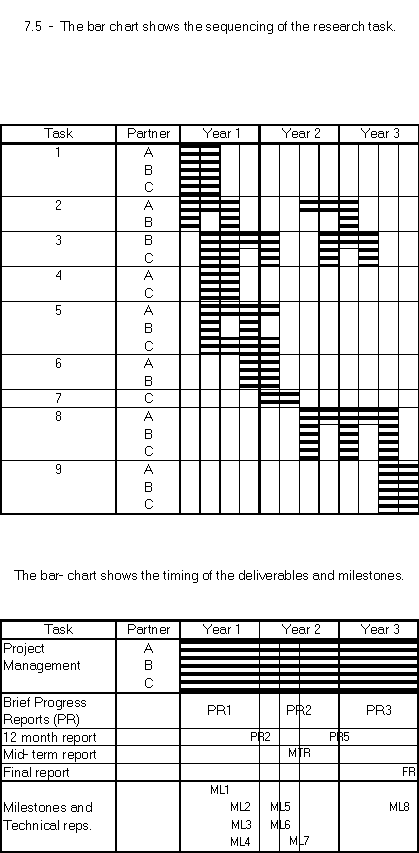
Full progress report every 12 months
Brief intermediate progress report (every 6 months between the main
reports)
Specialist technical reports on the individual tasks
A mid-term assessment report (in conjunction with the progress report
at the end of 18 months)
Laboratory and computer demonstrations
Exploitation report
Non confidential summary reports accompanying the annual and final
report.
Final report
7.3.
Milestones
The
following specialist technical reports will clearly indicate the achievement
to date:
1.
Results of the finalized studies regarding the test site for the
project (Month n° 6)
2.
Mobile covering design (Month n° 9)
3.
Results of studies regarding mining materials (Month n° 9)
4.
Results of studies regarding lining materials (Month n° 9)
5.
Results of studies regarding the treatment and confinement of filling
materials (Month n° 15)
6.
Mining plan (Month n° 15)
7.
Results of the economic study (Month n° 18)
8.
Results of on-site tests and assessments (Month n° 36)
Predicted
3-year time limit for the duration of the research.
7.4.
Mid-term assessment
By the
end of the 18th month a mid-term assessment report will have been completed on
the research progress made.
The
mid-term assessment report will be made on the satisfactory completion of part
of the following program items (task 1-7) before month 18.
At the
end of the 18th month a meeting will be held with all the partners (in the
coordination committee) for a mid-term assessment, and to redefine the
research programme for the second part of the project if necessary.
A
decision of the details of the mining tests (lining) will be taken.
The
revised work programme for the remainder of the project will also include
procedures for managing the utilization of the results.
7.5.
Program - bar chart
7.6.
Program - Manpower matrix